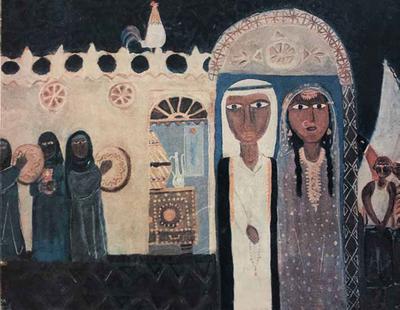
Perspectives on the Late Nasser Al-Yousif's Experience
Al-Wasat Newspaper
Al-Wasat newspaper article (Issue 3738) documenting an evening discussion at Abdulrahman Kanoo Cultural Forum about late Bahraini artist Nasser Al-Yousif (d. 2006). Features talks by Abdul Karim Al-Arayed (Al-Yousif's teacher and discoverer) and Abdullah Youssef, moderated by Mahmoud Al-Mulla. Includes Al-Areedh's memories of discovering Al-Yousif's talent, Abdullah Youssef's analysis of his artistic legacy, particularly focusing on his continued work after losing his sight, and excerpts from Al-Yousif's handwritten autobiography detailing his childhood in Muharraq, early artistic influences, and career development. The article commemorates the artist six years after his death.
- Archive no. ARC-20250714-001
- 1 page scanned
SubjectsNasser Al-Yousifناصر اليوسفAbdul Karim Al-Arayedعبد الكريم العريضAbdullah Youssefعبدالله يوسفMahmoud Al-Mullaمحمود الملاAbdulrahman Kanoo Cultural Forumملتقى عبد الرحمن كانو الثقافيAl-Wasatالوسط2012Bahraini artvisual arts movementMuharraqالمحرقdiving paintingsغوصThirst of Palmsعطش النخيلAli Abdullah Khalifaعلي عبدالله خليفةmawwalموالvision lossblindness and artposthumous tributeArab Visual Artists UnionSalmaniya Elementary SchoolAl-Arabi magazineDiver's Weddingعرس الغواص
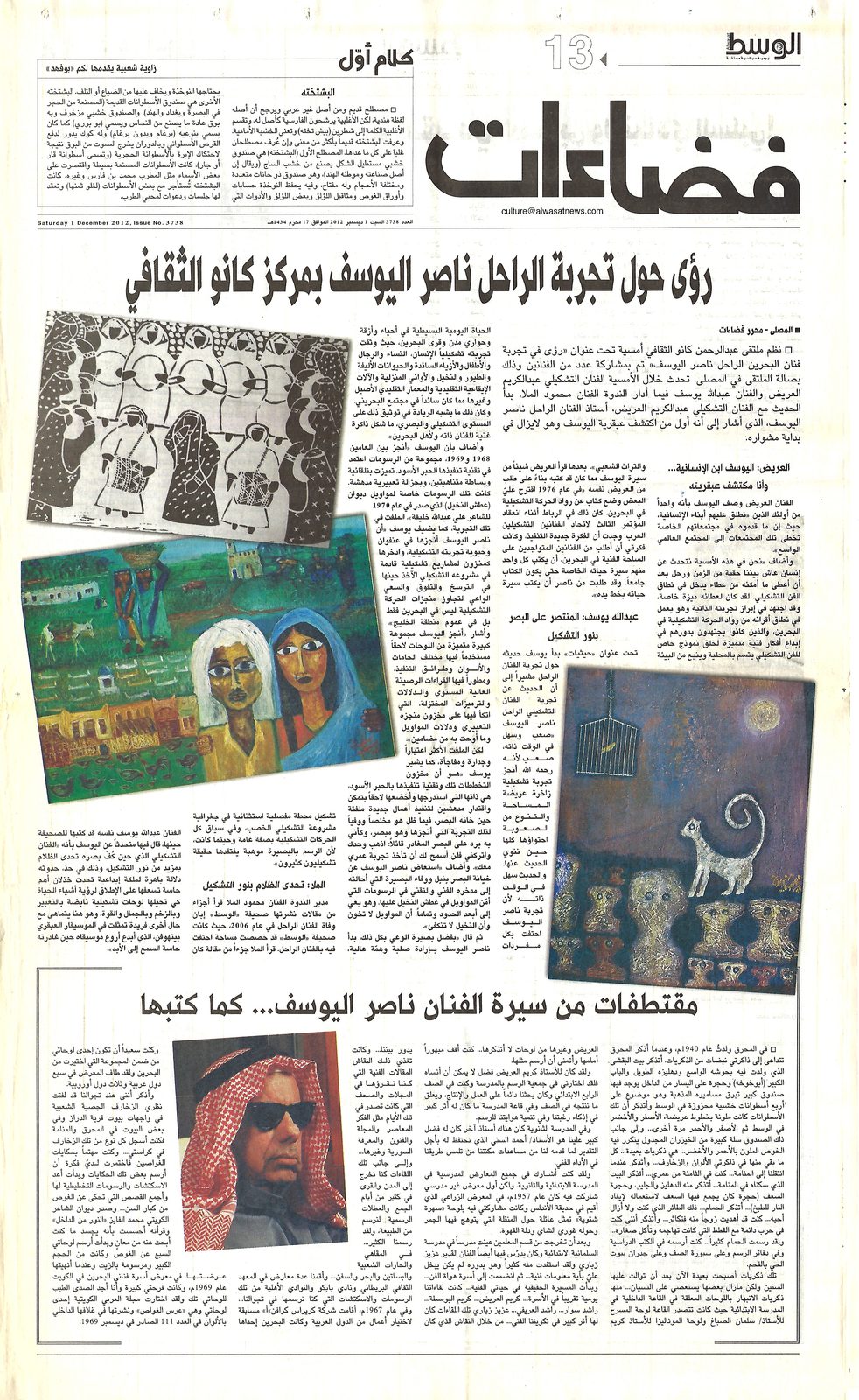
النص الأصلي
جريدة الوسط
العدد ٣٧٣٨ السبت ١ ديسمبر ٢٠١٢
قسم فضاءات
رؤى حول تجربة الراحل ناصر اليوسف بمركز كانو الثقافي
• المصلى - محرر فضاءات
نظم ملتقى عبد الرحمن كانو الثقافي أمسية تحت عنوان «رؤى في تجربة فنان البحرين الراحل ( ناصر اليوسف) تم بمشاركة عدد من الفنانين وذلك بصالة الملتقى في المصلى. تحدث خلال الأمسية الفنان التشكيلي عبد الكريم العريض والفنان عبدالله يوسف فيما أدار الندوة الفنان محمود الملا. بدأ الحديث مع الفنان التشكيلي عبد الكريم العريض، أستاذ الفنان الراحل ناصر اليوسف الذي أشار إلى أنه أول من اكتشف عبقرية اليوسف وهو لايزال في بداية مشواره.
العريض: اليوسف ابن الإنسانية... وأنا مكتشف عبقريته الفنان العريض وصف اليوسف بأنه وأحداً من أولئك الذين «نطلق عليهم أبناء الإنسانية، يث إن ما قدموه في مجتمعاتهم الخاص خطى تلك المجتمعات إلى المجتمع العالمي الواسع.
وأضاف “نحن في وطه الأمسية نتحدث عن إنسان عاش بيننا حقبة من الزمن ورحل بعد أن أعطى ما أمكنه من عطاء يدخل في نطاق الفن التشكيلي. لقد كان لعطائه ميزة خاصة. وقد اجتهد في إبراز تجربته الذاتية وهو يعمل في نطاق أقرانه من رواد الحركة التشكيلية في البحرين، و الذين كانوا يجتهدون بدورهم هي إبداع أفكار فنية متميزة لخلق نموذج خاص للفن التشكيلي يتسم بالمحلية وينبع من البيئة و التراث الشعبي”. بعدها قرأ العريض شيئا من سيرة اليوسف مما كان قد كتبه بناء على طلب من العريض نفسه “عام ١٩٧٦ اقترح علّي البعض وضع كتاب عن رواد الحركة التشكيلية في البحرين. كان ذلك في الرباط أثناء انعقاد المؤتمر الثالث لإتحاد الفنانين التشكيليين العرب. أن أطلب من الفنانين المتواجدين على الساحة الفنية في البحرين، أن يكتب كل واحد منهم سيرة حياته الخاصة حتى يكون الكتاب جامعا. وفد طلبت من ناصر أن يكتب سيرة حياته بخط يده”.
عبدالله يوسف: المنتصر على البصر بنور التشكيل
تحت عنوان «حيثيات» بدأ يوسف حديثه حول تجربة الفنان الراحل مشيرا الى أن الحديث عن تجربة الفنان التشكيلي الراحل ناصر اليوسف “صعب وسهل في الوقت ذاته، صعب لأنه رحمه الله أنجز تجربة تشكيلية زاخرة عريضة المساحة والتنوع من الصعوبة احتواؤها كلها حين ننوي الحديث عنها. والحديث سهل في الوقت ذاته لأن تجربة ناصر اليوسف احتفلت بكل مفردات الحياة اليومية البسيطة في أحياء وأزقة وحواري مدن وقرى البحرين، حيث وثقت تجريته تشكيليا الإنسان، النساء والرجال والأطفال والأزياء السائدة والحيوانات الأليفة والطيور والنخيل والأواني المنزلية والآلات الإيقاعية التقليدية والمعمار التقليدي الأصيل وغيرها مما كان سائدا في المجتمع البحريني. وكان ذلك يشبه الريادة في توثيق ذلك على المستوى التشكيلي والبصري، ماشكل ذاكرة غنية للفنان ذاته ولأهل البحرين”.
وأضاف بأن اليوسف “أنجز بين العامين ١٩٦٨ و ١٩٦٩، مجموعة من الرسومات اعتمد في تقنية تنفيذها الحبر الأسود. تميزت بتلقائية وبساطة متناهيتين، وبجزالة تعبيرية مدهشة. (عطش النخيل) الذي صدر في عام ١٩٧٠ للشاعر علي عبدالله خليفة، الملفت في تلك التجربة”، كما يضيف يضيف يوسف “أن ناصر اليوسف أنجزها في عنفوان وحيوية تجربته التشكيلية، وأدارها كمخزون لمشاريع تشكيلية قادمة في مشروعة التشكيلي الآخذ حينها في الترسخ والتفوق والسعي الواعي لتجاوز منجزات منجزات الحركة التشكيلية ليس في البحرين فقط بل في عموم منطقة الخليج”. وأشار “أنجز اليوسف مجموعة كبيرة متميزة من اللوحات لاحقا مستخدما فيها مختلف الخامات والألوان و طرائق التنفيذ، ومطورا فيها القراءات الرصينة العلية المستوى والدلالات والترميزات المختزلة، التي اتكأ فيها على مخزون منجزه التعبيري ودلالات المواويل وما أوحت به من مضامين”.
لكن الملفت الأكثر اعتباراً وجدارة ومفاجأة، كما يشير يوسف “هو أن مخزون التخططات تلك وتقنية تنفيذها بالحبر الأسود، هي ذاتها التي استدرجها وأخضعها لاحقا بتمكين و اقتدار مدهشين لتنفيذ أعمال جديدة ملفتة حين خانه البصر، فيما ظل هو مخلصا ووفيا إلى مدخره الفني والتقني في الرسومات التي أمن المواويل في عطش النخيل عليها. وهو يعي إلى أبعد الحدود وتماما، أن المواويل لا تخون وأن النخيل لا تنكفىء”.
ثم قال “بفضل بصيرة بإرادة صلبة وهمّة عالية، تشكيل محطة مفصلية استثنائية في جغرافية مشروعة التشكيلي الخصب، وفي سياق كل الحركات التشكيلية بصفة عامة وحيثما كانت، لأن الرسم بالبصيرة موهبة يفتقدها حقيقة تشكيليون كثيرون”.
الملا: تحدى الظلام بنور التشكيل
مدى الندوة الفنان محمود الملا قرأ اجزاء من مقالات نشرتها صحيفة «الوسط» إبان وقاه الفنان الراحل في عام 2006، حيت كانت صحيفه «الوسط)» قد خصصت مساحة احتفلت فيه بالفنان الراحل. قرأ الملا جزءا من مقالة كان الفنان عبدالله يوسف نفسة قد كتبها للصحيفة حينها، قال فيها متحدثا عن اليوسف بأنه “الفنان التشكيلي الذي حين كُفّ بصره تحدى الظلام بمزيد من نور التشكيل ، وذلك في تحدّ، حدوثه دلالة باهرة لملكة إبداعية تحدّت خذلان أهم حاسة تسعفها على الإطلاق لرؤية أشياء الحياة كي تحيلها لوحات تشكيلية نابضة بالتعبير وبالزخم وبالجمال والقوة. وهو هنا يتماهى مع حال أخرى فريدة تمثلت في الموسيقار العبقري بيتهوفن، الذي أبدع أروع موسيقاه حين غادرته حاسة السمع إلى الأبد”.
مقتطفات من سيرة الفنان ناصر اليوسف... كما كتبها
في المحرق ولدتُ عام 1940م، وعندما أذكر المحرق تتداعى إلى ذاكرتي نبضات من الذكريات. أتذكر بيت البقشى الذي ولدت فيه بحوشه الواسع ودهليزه الطويل والباب الكبير (أبوخوخه) وحجرة على اليسار من الداخل يوجد فيهاالكبير (أبوخوخه) وحجرة على اليسار من الداخل يوجد فيها سندوق كبير تبرق مساميره المذهبة وهو موضوع على أربع أسطوانات خشبية محزوزة في الوسط وأتذكر أن تلك الأسطوانات كانت ملونة بخطوط عريضة، الأصفر والأخضر في الوسط ثم الأصفر والأحمر مرة أخرى .. وإلى جانب لك الصندوق سلة كبيرة من الخيزران المجدول يتكرر فيه الخوص الملون بالأحمر والأخضر... هي ذكريات بعيدة... كل ما بقي منها في ذاكرتي الألوان والزخارف... وأتذكر عندما انتقلنا إلى المنامة... كنت في الثامنة من عمري... أتذكر البيت الذى سكناه فى المنامة... أتذكر منه الدهليز والجليب وحجرة سعف (حجرة كان يجمع فيها السعف لاستعماله لإيقاد النار للطبخ)... أتذكر الحمام... ذلك الطائر الذي كنت ولا أزال أحبه... كنت قد أهديت زوجاً منه فتكاثر... وأتذكر أننى كنت في حرب دائمة مع القطط التي كانت تهاجمه وتأكل صغارة .. ولقد رسمت الحمام كثيرا .. كنت أرسمج في الكتب الدراسية وفي دفاتر الرسم وعلى سبورة الصف وعلى جدران بيوت الحي بالفحم.
تلك الذكريات أصبحت بعيدة الآن بعد أن توالت عليها السنين ولكن مازال بعضها يستعصي على النسيان... منها ذكريات الانبهار باللوحات المعلقة في القاعة الداخلية في المدرسة الابتدائية حيث كانت تتصدر القاعة لوحة المسرح الأستاذ/ سلمان الصباغ ولوحة الموناليزا للأستاذ كريم العريض وغيرها من لوحات لا أتذكرها... كنت أقف مبهوراً أمامها وأتمنى أن أرسم مثلها.
ولقد كان للأستاذ كريم العريض فضل لا يمكن أن أنساه فلقد اختارني في جمعية الرسم بالمدرسة وكنت في الصفالرابع الابتدائي وكان يحثنا دائماً على العمل والإنتاج، ويعلق ما ننتجه في الصف وفي قاعة المدرسة ما كان له أثر كبير في إذكاء رغبتنا وفي تنمية هواياتنا للرسم.
وفي المدرسة الثانوية كان هناك أستاذ آخر كان له فضل كبير علينا هو الأستاذ/ أحمد السني الذي نحتفظ له بأجل التقدير لما قدمه لنا من مساعدات مكنتنا من تلمس طريقنا في الأداء الفني.
وبقد كنت أشارك في جميع المعارض المدرسية في المدرسة الابتدائية والثانوية. ولكن أول معرض غير مدرسي
شاركت فيه كان عام 1957م، في المعرض الزراعي الذي أقيم في حديقة الأندلس وكانت مشاركتي فيه بلوحة ((سهرة شتوية)) تمثل عائلة حول المنقلة التي يتوهج فيها الجمر وحوله غوري الشاي ودلة القهوة.
وبعد أن تخرجت من قسم المعلمين عينتِ مدرساً في مدرسة السلمانية الابتدائية وكان يدرّس فيها أيضاً الفنان القدير عزيز زباري ولقد استفدت منه كثيراً وهو بدوره لم يكن يبخل عليّ بأية معلومات فنية... ثم انضممت إلى أسرة هواة الفن. وبدأت المسيرة الحقيقية في حياتي الفنية... كانت لقاءاتنا يومية تقريباً في الأسرة... كريم العريض... كريم البوسطة...راشد سوار... راشد العريفي... عزيز زباري تلك اللقاءات كان لها اثر كبير في تكويننا الفني .. من خلال النقاش الذي كان يدور بيننا .. وكانت المقالات الفنية التي كنا نقرؤها في المجلات والصحف التي كانت تصدر في تلك الأيام مثل الفكر المعاصر والمجلة والفنون والمعرفة السورية وغيرها... وإلى جانب تلك اللقاءات كنا نخرج إلى المدن والقرى في كثير من أيام الجمع والعطلات الرسمية لنرسم من الطبيعة، ولقد رسمنا الكثير..في المقاهي والحارات الشعبية والبساتين والبحر والسفن... وأقمنا عدة معارض في المعهد الثقافي البريطاني ونادي بابكو والنوادي الأهلية من تلك الرسومات و الإسكتشات التي كنا نرسمها في تجوالنا .. وفي عام ١٩٦٧م أقامت شركة كريراس كرافن “أ” مسابقة لإختيار أعمال من الدول العربية وكانت البحرين إحداها وكنت سعيداً أن تكون إحدى لوحاتي من ضمن المجموعة التي اختيرت من البحرين ولقد طاف المعرض في سبع دول عربية وثلاث دول أوروبية.
وأذكر أننى عند تجوالنا قد لفتت نظري الزخارف الجصية الشعبية في واجهات بيوت قرية الدراز وفي عض البيوت في المحرق والمنامة فكنت أسجل كل نوع من تلك الزخارف في كراستي … وكنت مهتما بحكايات الغواصين فاختمرت لدي فكرة أن أرسم بعض تلك الحكايات وبدأت أعد الاسكتشات والرسومات التخطيطية لها واجمع القصص التي تحكى عن الغوص من كبار السن... وصدر ديوان الشاعر الكويتي محمد الفايز “النور من الداخل” وقرأته أحسست بأنه يجسد ما كنت أبحث عنه من معانٍ وبدأت أرسم لوحاتي السبع عن الغوص وكانت من الحجم الكبير ومرسومة بالزيت وعندما أنهيته عرضتها فى معرض أسرة فنانى البحرين فى الكويت عام 1969م، وكانت فرحتى كبيرة وأنا أجد الصدى الطيب للوحاتي تلك ولقد اختارت مجلة العربي الكويتية إحدى وحاتي وهي «عرس الغواص» ونشرتها في غلافها الداخلي بالألوان في العدد 111 الصادر في ديسمبر 1969.
Translation
Al-Wasat Newspaper Article: Perspectives on the Late Nasser Al-Yousif's Experience at Kanoo Cultural Center
Al-Wasat Newspaper
Issue 3738, Saturday, December 1, 2012
Spaces Section
By Al-Musalla - Spaces Editor
Evening Discussion on Bahrain's Late Artist
The Abdulrahman Kanoo Cultural Forum organized an evening event titled "Perspectives on the Experience of Bahrain's Late Artist Nasser Al-Yousif" with the participation of several artists at the Forum's hall in Al-Musalla. Speaking during the evening were visual artist Abdul Karim Al-Orayed and artist Abdullah Youssef, while artist Mahmoud Al-Mulla moderated the discussion. The conversation began with visual artist Abdul Karim Al-Orayed, the late artist Nasser Al-Yousif's teacher, who noted that he was the first to discover Al-Yousif's genius while he was still at the beginning of his journey.
Al-Areedh: Al-Yousif is a Son of Humanity... and I Discovered His Genius
Artist Al-Orayed described Al-Yousif as one of those "whom we call sons of humanity, as what they presented in their specific societies transcended those societies to the broad global community."
He added, "This evening, we are talking about a person who lived among us for a period of time and departed after giving what he could in the field of visual arts. His giving had a special characteristic. He strived to highlight his personal experience while working within the scope of his peers among the pioneers of the visual arts movement in Bahrain, who were in turn striving to create distinguished artistic ideas to create a special model for visual art characterized by locality and stemming from the environment and folk heritage."
Al-Orayed then read something from Al-Yousif's biography that had been written at Al-Areedh's request: "In 1976, some suggested I compile a book about the pioneers of the visual arts movement in Bahrain. This was in Rabat during the third conference of the Arab Visual Artists Union. I asked the artists present on the artistic scene in Bahrain for each one to write their own life story so the book would be comprehensive. I asked Nasser to write his life story in his handwriting."
Abdullah Youssef: The Victor Over Sight Through the Light of Art
Under the title "Circumstances," Youssef began his talk about the late artist's experience, noting that speaking about the late visual artist Nasser Al-Yousif's experience "is both difficult and easy at the same time. Difficult because, may God have mercy on him, he accomplished a rich artistic experience, broad in scope and variety, making it difficult to contain it all when we intend to speak about it. And the talk is easy at the same time because Nasser Al-Yousif's experience celebrated all the simple daily life vocabulary in the neighborhoods, alleys, and quarters of Bahrain's cities and villages, where his experience artistically documented humans - women, men, and children - prevailing fashions, domestic animals, birds, palm trees, household utensils, traditional percussion instruments, authentic traditional architecture, and other things prevalent in Bahraini society. This was like pioneering in documenting that on the visual and artistic level, forming a rich memory for the artist himself and the people of Bahrain."
He added that Al-Yousif "accomplished between 1968 and 1969 a group of drawings using black ink in their execution technique. They were characterized by extreme spontaneity and simplicity, and stunning expressive eloquence. 'Thirst of Palms' published in 1970 for poet Ali Abdullah Khalifa - what's striking about that experience," as Youssef adds, "is that Nasser Al-Yousif accomplished it in the vigor and vitality of his artistic experience, managing it as a reservoir for upcoming artistic projects in his artistic project that was then becoming established, excelling, and consciously seeking to surpass the achievements of the visual arts movement not only in Bahrain but throughout the Gulf region."
He noted, "Al-Yousif later accomplished a large distinguished group of paintings using various materials, colors, and execution methods, developing in them solid, high-level readings, significations, and condensed symbolisms, which he based on the reservoir of his expressive achievement and the significations of mawwals and what they suggested in terms of content."
But what's most striking, worthy, and surprising, as Youssef points out, "is that the reservoir of those sketches and their execution technique in black ink are the same ones he later drew upon and subjected with stunning mastery and capability to execute striking new works when his sight failed him, while he remained loyal and faithful to his artistic and technical savings in the drawings that secured the mawwals in 'Thirst of Palms.' He was aware to the furthest extent and completely that mawwals don't betray and palm trees don't retreat."
He then said, "Thanks to insight with solid will and high determination, he formed an exceptional pivotal station in the geography of his fertile artistic project, and in the context of all artistic movements in general, wherever they were, because drawing with insight is a talent that many artists truly lack."
Al-Mulla: He Challenged Darkness with the Light of Art
Moderator artist Mahmoud Al-Mulla read excerpts from articles published by Al-Wasat newspaper during the late artist's death in 2006, when Al-Wasat had dedicated space celebrating the late artist. Al-Mulla read part of an article that artist Abdullah Youssef himself had written for the newspaper then, in which he said about Al-Yousif that he was "the visual artist who, when his sight was blocked, challenged darkness with more light of art, in a challenge whose occurrence is a brilliant indication of a creative faculty that challenged the betrayal of the most important sense that helps it at all to see life's things in order to transform them into visual paintings pulsing with expression, momentum, beauty, and strength. Here he identifies with another unique case represented in the genius musician Beethoven, who created his most wonderful music when the sense of hearing left him forever."
Excerpts from Artist Nasser Al-Yousif's Biography... As He Wrote It
"In Muharraq, I was born in 1940, and when I mention Muharraq, pulses of memories come to my mind. I remember the Al-Baqshi house where I was born with its wide courtyard, long corridor, and the big door (Abu Khokha), and a room on the left from inside where there was a large chest with gleaming gilded nails placed on four wooden cylinders grooved in the middle. I remember those cylinders were colored with wide stripes - yellow and green in the middle, then yellow and red again... Next to that chest was a large basket of woven bamboo where colored straw repeated in red and green... These are distant memories... All that remains of them in my memory are colors and decorations...
I remember when we moved to Manama... I was eight years old... I remember the house we lived in in Manama... I remember its corridor, the well, and the palm frond room (a room where palm fronds were collected for use in lighting fires for cooking)... I remember the pigeons... that bird I loved and still love... I had been given a pair that multiplied... I remember I was in constant war with cats that would attack them and eat their young... I have drawn pigeons a lot... I would draw them in textbooks, in drawing notebooks, on the classroom blackboard, and on the walls of neighborhood houses with charcoal.
Those memories have become distant now after the years have passed, but some still resist forgetting... Among them are memories of being dazzled by the paintings hanging in the inner hall of the elementary school, where the hall was headed by a theater painting by Mr. Salman Al-Sabbagh and the Mona Lisa by Mr. Karim Al-Orayed, and other paintings I don't remember... I would stand dazzled before them and wish to draw like them.
Mr. Karim Al-Orayed had a favor I can never forget - he selected me for the school's drawing society when I was in fourth grade elementary, and he would always urge us to work and produce, hanging what we produced in the classroom and school hall, which had a great effect in igniting our desire and developing our drawing hobbies.
In secondary school, there was another teacher who had great favor upon us - Mr. Ahmed Al-Sunni, for whom we hold the highest appreciation for the help he provided us that enabled us to feel our way in artistic performance.
I participated in all school exhibitions in elementary and secondary school. But the first non-school exhibition I participated in was in 1957, in the agricultural exhibition held in Andalus Garden, and my participation was with a painting, "Winter Evening," representing a family around a brazier glowing with embers, surrounded by a tea kettle and coffee pot.
After graduating from the teachers' section, I was appointed as a teacher at Salmaniya Elementary School, where the distinguished artist Aziz Zubari also taught, and I benefited greatly from him as he never withheld any artistic information from me... Then I joined the family of art enthusiasts. And the real journey in my artistic life began... Our meetings were almost daily in the family... Karim Al-Areedh... Karim Al-Bosta... Rashid Sawar... Rashid Al-Arifi... Aziz Zubari. Those meetings had a great impact on our artistic formation... through the discussions that took place among us... and the artistic articles we read in magazines and newspapers published in those days like Contemporary Thought, Al-Majalla, Arts, Syrian Knowledge, and others...
Alongside those meetings, we would go out to cities and villages on many Fridays and official holidays to draw from nature, and we drew a lot... in cafes, popular neighborhoods, orchards, the sea, and ships... We held several exhibitions at the British Cultural Institute, Bapco Club, and local clubs, from the drawings and sketches we made during our wanderings.
In 1967, Carreras Craven "A" company held a competition to select works from Arab countries, Bahrain being one of them, and I was happy that one of my paintings was among the group selected from Bahrain. The exhibition toured seven Arab countries and three European countries.
I remember that during our wanderings, the popular plaster decorations on the facades of houses in Diraz village and in some houses in Muharraq and Manama caught my attention, so I would record every type of those decorations in my notebook... I was interested in divers' stories, so the idea fermented in me to draw some of those stories. I began preparing sketches and preliminary drawings for them and collecting stories told about diving by the elderly...
The collection of Kuwaiti poet Mohammed Al-Fayez, "Light from Within," was published, and when I read it, I felt it embodied the meanings I was searching for. I began painting my seven paintings about diving - they were large-sized and painted in oil. When I finished them, I exhibited them at the Bahrain Artists Family exhibition in Kuwait in 1969. My joy was great as I found a positive response to those paintings. Kuwait's Al-Arabi magazine selected one of my paintings, "Diver's Wedding," and published it in color on its inside cover in issue 111, December 1969."
Works discussed on this page