"Artist Nasser Al-Yousif on a Long Research Journey in Shaping Heritage"
Extended interview on artistic philosophy, heritage, and Bahraini art scene
In-depth magazine interview with artist Nasser Al-Yousif exploring his two-decade artistic journey and philosophy. Interview covers his approach to heritage as "renewable life" connecting generations, critique of growing cultural alienation and death of traditional celebrations, his teaching career (1959-1972) and its influence on his artistic development, shift from direct observation to literature-based inspiration, loss of ten pearl diving paintings inspired by Mohammed Al-Fayez's poetry, influence of poetry and music on his work, challenges of exhibition venues in Bahrain limited to hotels, and future plans for publishing books about Bahraini art including works on late artist Yaqoub Yousuf Qasim and "The Story of Fine Arts in Bahrain" by Kareem Al-Areed. Provides insight into his reading habits from childhood, early influences including Ibrahim Al-Areed and Hassan Al-Jashi, and his glass/mirror workshop business.
- Archive no. ARC-20250710-004
- 1 page scanned
SubjectsNasser Al-Yousif interviewheritage and contemporary artcultural alienationpearl diving paintingsMohammed Al-Fayez poetry influenceteaching career 1959-1972Bahrain art sceneexhibition challengeshotel galleriesIbrahim Al-AreedHassan Al-JashiAl-Mutanabbi poetryYaqoub Yousuf QasimKareem Al-Areedglass workshoptraditional celebrationsScottish educationTharwat Okasha Islamic Artpopular neighborhoodsBahrain Association Contemporary Art
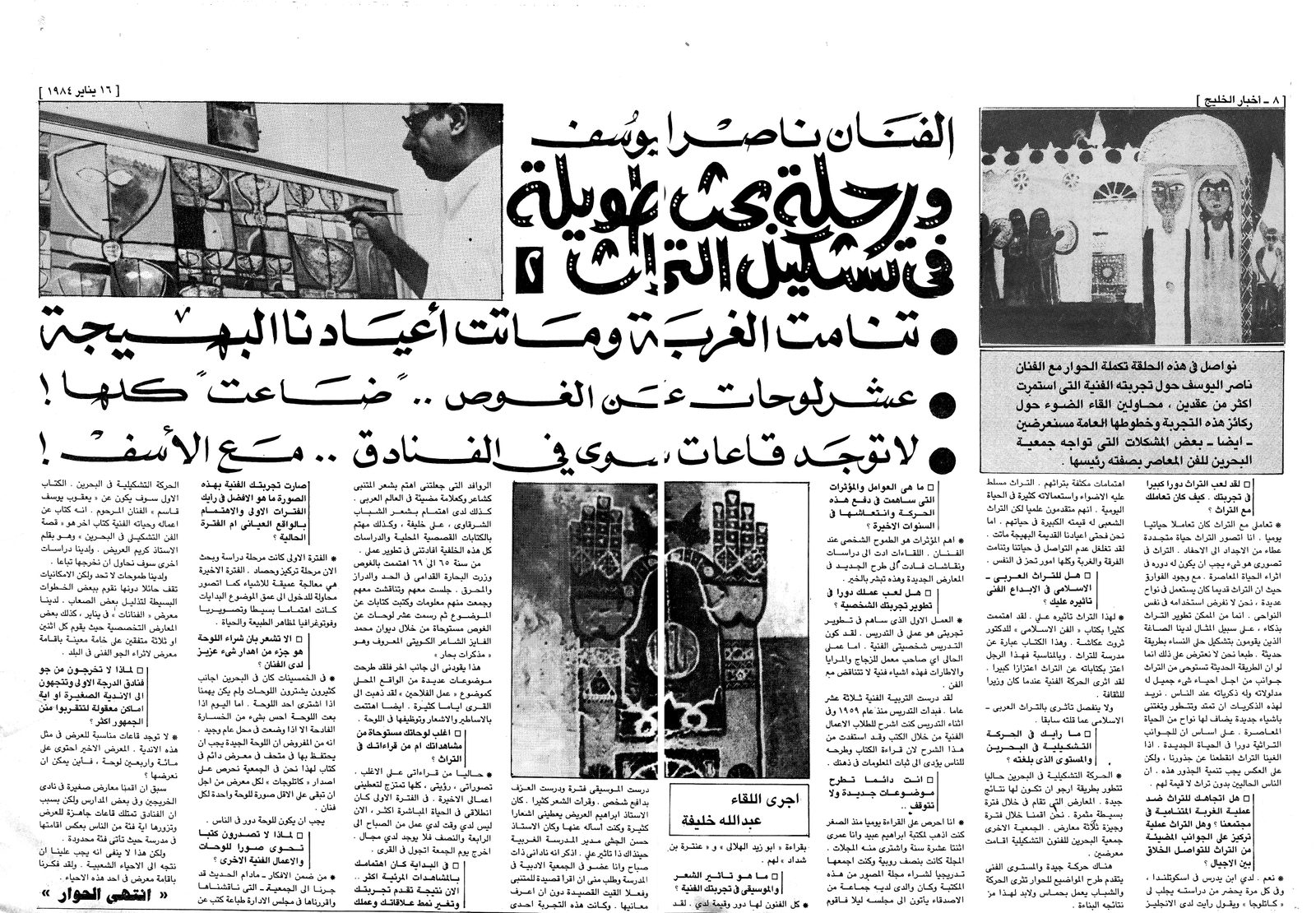
النص الأصلي
الفنَان ناصراليوسف
في رحلة بحث طويلة في تشكيل التراث
اجرى اللقاء: عبدالله خليفة
• تنامت الغربَة وماتت أعيَادنا البهيجة
• عشر لوحات عَن الغوص .. ضَاعت كلها!
• لا توجَد قاعات سوى في الفنادق .. مَع الأسف !
نواصل في هذه الحلقة تكملة الحوار مع الفنان ناصر اليوسف حول تجربته الفنية التى استمرت اكثر من عقدين ، محاولين إلقاء الضوء حول ركائز هذه التجربة وخطوطها العامة مستعرضين- أيضا - بعض المشكلات التى تواجه جمعية البحرين للفن المعاصر بصفته رئيسها.
- لعد لعب التراث دورا كبيرا فى تجربتك . كيف كان تعاملك مع التراث ؟
تعاملى مع التراث كان تعاملا حياتيا يوميا . انا اتصور التراث حياة متجددة عطاء من الاجداد الى الاحفاد . التراث فى تصورى هو شىء يجب ان يكون له دورة فى إثراء الحياة المعاصرة . مع وجود الفوارق حيث ان التراث قديما كان يستعمل في نواح عديدة، نحن لا نفرض استخدامة في نفس النواحي. إنما من الممكن تطوير التراث بذكاء، على سبيل المثال الصاغة الذين يشكلون حلي النساء بطريقة حديثة. طبعا نحن لا نعترض على ذلك انما لو الطريقة الحديثة تستوحي من التراث جوانب من اجل احياء شيء جميل جميل له مدلولات وله ذكريات لدى الناس. نريد لهذه الذكريات ان تمتد و تتطور وتغتني بأشياء جديدة يضاف لها نواح من الحياة المعاصرة. على اساس ان الجوانب التراثية دورا في الحياة الجديدة. اذا الغينا التراث انقطعنا عن جذورنا، ولكن على العكس يجب تنمية الجذور هذه. ان الناس الحاليين بدون تراث لا قيمة لهم.
- هل اتجاهك للتراث ضد عملية الغربة المتنامية فى مجتمعنا ؟ وهل التراث عملية تركيز على الجوانب المضيئة من التراث للتواصل الخلاق بين الأجيال ؟
نعم. لدي ابن يدرس فى اسكتلندا، وفى كل مرة يحضر من دراسته يجلب لى (كاتلوجا) ويقول رأيت لدى الإنجليز اهتمامات مكثفة بتراثهم . التراث تسلط عليه الأضواء واستعمالاته كثيرة فى الحياة اليومية . انهم متقدمون علميا لكن التراث الشعبى له قيمته الكبيرة فى حياتهم . اما نحن فحتى اعيادنا القديمة البهيجة ماتت. لقد تغلغل عدم التواصل فى حياتنا وتنامت الفرقة والغربة وكلها أمور تحز في النفس.
- هل للتراث العربي الإسلامي في الإبداع الفني تأثيره عليك؟
لهذا التراث تأثيره على. لقد اهتممت كثيرا بكتاب (الفن الاسلامى) للدكتور ثروت عكاشة . وهذا الكتاب عبارة عن مدرسة للتراث. وبالمناسبة فهذا الرجل اعتز بكتاباته عن التراث اعتزازا كبيرا. لقد اثرى الحركة الفنية عندما كان وزيرا للثقافة. ولا ينفصل تأثري بالتراث العربي - الإسلامي عما قلته سابقا.
- ما رأيك فى الحركة التشكيلية فى البحرين و المستوى الذي بلغته؟
الحركة التشكيلية فى البحرين حاليا تتطور بطريقة ارجو ان تكون لها نتائج جيدة . المعارض التى تقام فى خلال فترة بسيطة مثمرة. نحن أقمنا خلال فترة وجيزة ثلاثة معارض. الجمعية الأخرى جمعية البحرين للفنون التشكيلية أقامت معرضين.
هناك حركة جيدة والمستوى الفني يتقدم طرح المواضيع للحوار تثري الحركة والشباب يعمل بحماس ولابد من نتائجه البناءة.
- ما هي العوامل والمؤثرات التي ساهمت فى دفع هذه الحركة وانتعاشها في السنوات الأخيرة؟
أهم المؤثرات هو الطموح الشخصي عند الفنان. اللقاءات أدت إلى دراسات ونقاشات قاده إلى طرح الجديد في المعارض الجديدة و هذه تبشر بالخير.
- هل لعب عملك دورا في تطوير تجربتك الشخصية ؟
العمل الأول الذى ساهم فى تطوير تجربتى هو عملى فى التدريس . لقد كون التدريس شخصيتي الفنية . اما عملي الحالي اي صاحب معمل للزجاج والمرايا والاطارات فهذه أشياء فنية لا تتناقض مع الفن.
درّست التربية الفنية ثلاثة عشر عاما . فبدأت التدريس منذ عام ١٩٥٩ , في أثناء التدريس كنت اشرح للطلاب الأعمال الفنية من خلال الكتب وقد استفدت من هذا الشرح لان قراءة الكتاب وطرحه للناس يؤدى الى تبات المعلومات في ذهنك.
- انت دائما تطرح موضوعات جديدة ولا تتوقف..
* انا احرص على القراءة يوميا منذ الصغر كنت أذهب لمكتبة ابراهيم عبيد وانا عمرى اثنتا عشرة سنة واشتري، منه المجلات. المجلة كانت بنصف روبية وكنت اجمعها تدريجيا لشراء مجلة المصور من هذه لمكتبة وكان والدى لديه جماعة من الأصدقاء يأتون إلى مجلسه ليلا فأقوم بقراءة « ابو زيد الهلالي » و « عنترة بن شداد » لهم .
- ما هو تأثير الشعر او الموسيقى فى تجربتك الفنية ؟
* كل الفنون لها دور وقيمة لدى . لقد درست الموسيقى فترة ودرست العزف بدافع شخصي. وقرأت السعر كثيرا. كان الأستاذ إبراهيم العريض يعطيني اشعارا كثيرة وكنت أسأله عنها وكان الأستاذ حسن الجشي مدير المدرسة الغربية حينذاك ذا تأثير علي. اذكر انه ناداني ذات صباح و أنا عضو في الجمعية الأدبية في المدرسة وطلب مني أن أقرأ قصيدة للمتنبي وفعلا القيت القصيدة دون أن أعرف معانيها. وكانت هذه التجربة احدى الروافد التي جعلتني اهتم بشعر المتنبي كشاعر و كعلامة مضيئة في العالم العربي.
كذلك لدي اهتمام بشعر الشباب الشقاوي، علي خليفة، وكذلك مهتم الكتابات القصصية المحلية والدراسات كل هذه الخلفية أفادتني في تطوير عملي.
من سنة ٦٥ الى ٦٩ اهتممت بالغوص وزرت البحارة القدامى في الحد والدراز والمحرق. جلست معهم وتناقشت معهم وسمعت منهم معلومات وكتبت كتاباتكن الموضوع ثم رسمت عشر لوحات عن الغوص مستوحاة من ديوان محمد الفايز الشاعر الكويتي المعروف وهو (مذكرات بحار).
هذا يقودني الى جانب اخر فلقد طرحت موضوعات عديدة من الواقع المحلي كموضوع (عمل الفلاحين) لقد ذهبت الى القرى اياما كثيرة. ايضا اهتممت بالاساطير والاشعار و توظيفها في اللوحة.
- أغلب لوحاتك مستوحاة من مشاهدتك ام من قراءاتك في التراث؟
حاليا من قراءاتي على الأغلب. توراتي، رؤيتي، كلها تمتزج لتعطيني اعمالي الأخيرة. في الفترة الاولى كان انطلاقي في الحياة المباشرة اكثر، الان ليس لدي وقت لدي عمل من الصباح الى الرابعة والنصف فلا يوجد لدي مجال. آخر يوم الجمعة اتجول في القرى.
- في البداية كان اهتمامك بالمشاهدات المرئية اكثر.. الان نتيجة تقدم تجربتك وتغير نمط علاقاتك وعملك صارت تجربتك الفنية بهذه الصورة ماهو الافضل في رأيك الفترات الأولى والاهتمام بالواقع العياني ام الفترة الحالية؟
* الفترة الاولى كانت مرحلة دراسة وبحث الان مرحلة تركيز وحصاد . الفترة الاخيرة هي معالجة عميقة للأشياء كما اتصور محاولة للدخول الى عمق الموضوع البدايات كانت اهتماما بسيطا وتصويريا وفوتوغرافيا لمظاهر الطبيعة والحياة.
- الا تشعر بان شراء اللوحة هو جزء من إهدار شيء عزيز لدى الفنان ؟
* فى الخمسينات كان فى البحرين أجانب كثيرون يشترون اللوحات ولم يكن يهمه اذا اشترى احد اللوحة . أما اليوم إذا بيعت اللوحة أحس بشيء من الخسارة الفادحة إلا إذا وضعت في محل عام و جيد.
انه من المفروض ان اللوحة الجيدة يجب ان يحتفظ بها في متحف في معرض دائم في كتاب لهذا نحن في الجمعية نحرص على إصدار (كتالوجات) لكل معرض من اجل ان تبقى على الاقل صورة للوحة واحدة لكل فنان.
يجب أن يكون للوحة دور في الناس.
لماذا لاتصدرون كتبا تحوي صورا للوحات و الأعمال الفنية الأخرى؟
* من ضمن الافكار - مادام الحديث قد جرنا الى الجمعية - التى ناقشناها وأقرر ناها فى مجلس الإدارة طباعة كتب عن الحركة التشكيلية في البحرين. الكتاب الاول سوف يكون عن (يعقوب يوسف قاسم) الفنان المرحوم. انه كتاب عن أعماله وحياته الفنية كتاب آخر هو (قصة الفن التشكيلي في البحرين) وهو بقلم الاستاذ كريم العريض. ولدينا دراسات اخرى سوف نحاول ان نخرجها تباعا.
- لماذا لا تخرجون من جو فنادق الدرجة الأولى وتتجهون الى الاندية الصغيرة او اية اماكن معقولة لتتقربوا من الجمهور أكثر؟
لا توجد قاعات مناسبة للعرض فى مثل هذه الاندية . المعرض الاخير احتوى على مائة وأربعين لوحة ، فأين يمكن نعرضها؟
سبق ان أقمنا معارض صغيرة فى نادى الخريجين وفى بعض المدارس ولكن بسبب ان الفنادق ، تمتلك قاعات جاهزة للعرض وتزورها اية فئة من الناس بعكس إقامتها فى مدرسة حيث تأتي فئة محدودة.
ولكن هذا لا ينفى أنه يجب علينا ان نتجه الى الاحياء الشعبية . ولقد فكرنا بإقامة معرض فى أحد هذه الأحياء.
Translation
Artist Nasser Al-Yousif on a Long Research Journey in Shaping Heritage
• Alienation has grown, and our joyful celebrations have died. • Ten paintings about pearl diving... all lost! • There are no galleries except in hotels... unfortunately!
We continue in this episode the completion of the dialogue with artist Nasser Al-Yousif about his artistic experience that lasted more than two decades, attempting to shed light on the foundations of this experience and its general lines, also reviewing some of the problems facing the Bahrain Association for Contemporary Art in his capacity as its president.
• Heritage has played a major role in your experience. How were you dealing with heritage?
My dealing with heritage was a daily life dealing. I envision heritage as a renewable life, a gift from grandparents to grandchildren. Heritage, in my conception, is something that should have a role in enriching contemporary life. With existing differences where heritage was used in many aspects in the past, we don't impose using it in the same aspects. Rather, it's possible to develop heritage intelligently, for example, jewelers who shape women's jewelry in a modern way. Of course, we don't object to that, but if the modern method draws inspiration from heritage aspects in order to revive something beautiful that has connotations and memories for people. We want these memories to extend, develop, and be enriched with new things added to them from contemporary life. Based on the heritage aspects, having a role in the new life. If we eliminate heritage, we cut ourselves off from our roots, but on the contrary, we must nurture these roots. People today without heritage have no value.
• Is your orientation toward heritage against the growing process of alienation in our society? Is heritage a process of focusing on the bright aspects of heritage for creative communication between generations?
Yes. I have a son studying in Scotland, and every time he comes from his studies, he brings me catalogs and says he saw the English have an intense interest in their heritage. Heritage is spotlighted and has many uses in daily life. They are scientifically advanced, but folk heritage has great value in their lives. As for us, even our old joyful celebrations have died. Lack of communication has penetrated our lives, and division and alienation have grown, all matters that hurt the soul.
• Does Arab-Islamic heritage in artistic creativity have its influence on you?
This heritage has its influence on me. I was very interested in the book "Islamic Art" by Dr. Tharwat Okasha. This book is like a school for heritage. By the way, I greatly respect this man's writings about heritage. He enriched the artistic movement when he was Minister of Culture. My influence by Arab-Islamic heritage is not separate from what I said before.
• What is your opinion on the fine arts movement in Bahrain and the level it has reached?
The fine arts movement in Bahrain is currently developing in a way I hope will have good results. The exhibitions held in a short period are fruitful. We held three exhibitions in a short period. The other association, the Bahrain Fine Arts Association, held two exhibitions. There is good movement, and the artistic level is advancing. Subject presentations for dialogue enrich the movement and youth work with enthusiasm, and constructive results are inevitable.
• What are the factors and influences that contributed to pushing this movement and its revival in recent years?
The most important influence is personal ambition in the artist. Meetings led to studies and discussions that led to presenting the new in new exhibitions, and these are promising.
• Did your work play a role in developing your personal experience?
The first work that contributed to developing my experience is my work in teaching. Teaching formed my artistic personality. As for my current work, meaning owning a glass, mirrors, and frames workshop, these are artistic things that don't contradict art. I studied art education for thirteen years. I started teaching in 1959. During teaching, I was explaining artworks to students through books, and I benefited from this explanation because reading a book and presenting it to people leads to information being established in your mind.
• You always present new subjects and don't stop...
I've been keen on reading daily since childhood. I used to go to Ibrahim Obaid's library when I was twelve years old and buy magazines from him. The magazine cost half a rupee, and I would save gradually to buy Al-Musawwar magazine from this library. My father had a group of friends who came to his sitting room at night, so I would read "Abu Zaid Al-Hilali" and "Antar bin Shaddad" to them.
• What is the influence of poetry or music on your artistic experience?
All arts have a role and value for me. I studied music for a period and studied playing from personal motivation. I read poetry a lot. Professor Ibrahim Al-Areed used to give me many poems, and I would ask him about them. Professor Hassan Al-Jashi, director of Al-Gharbiya School at that time, had an influence on me. I remember he called me one morning when I was a member of the Literary Society at school and asked me to read a poem by Al-Mutanabbi. I actually recited the poem without knowing its meanings. This experience was one of the tributaries that made me interested in Al-Mutanabbi's poetry as a poet and as a bright sign in the Arab world.
I also have an interest in youth poetry, Shaqawi, and Ali Khalifa, and I'm also interested in local story writings and studies. All this background helped me develop my work.
From 1965 to 1969, I was interested in pearl diving and visited old sailors in Al-Hadd, Al-Diraz, and Muharraq. I sat with them, discussed with them, heard information from them, and wrote about the subject. Then I painted ten paintings about pearl diving inspired by the collection of Mohammed Al-Fayez, the well-known Kuwaiti poet, which is "Memoirs of a Sailor."
This leads me to another aspect - I presented many subjects from local reality, like the subject of "farmers' work." I went to the villages for many days. I was also interested in legends and poems and employing them in paintings.
• Are most of your paintings inspired by your observations or from your readings in heritage?
Currently, mostly from my readings. My heritage, my vision, all mix to give me my recent works. In the first period, my departure was more direct in life; now I don't have time - I have work from morning to 4:30, so I don't have scope. Only on Fridays ّ do tour the villages.
• In the beginning, your interest was more in visual observations... now, as a result of your experience's progress and changing pattern of your relationships and work, your artistic experience became this way. What is better in your opinion, the early periods and interest in concrete reality, or the current period?
The first period was a stage of study and research, now it's a stage of focus and harvest. The last period is deep treatment of things, as I envision, an attempt to enter the depth of the subject. The beginnings were simple, pictorial, and photographic interest in aspects of nature and life.
• Don't you feel that buying a painting is part of wasting something dear to the artist?
In the fifties, there were many foreigners in Bahrain who bought paintings, and it didn't matter to me if someone bought the painting. But today, if I sell a painting, I feel some devastating loss unless it's placed in a public and good place. It's supposed that a good painting should be kept in a museum, in a permanent exhibition, or in a book. That's why we in the association are keen on issuing catalogs for each exhibition so that at least one picture of one painting for each artist remains. The painting should have a role among people.
• Why don't you issue books containing pictures of paintings and other artworks?
Among the ideas, since the conversation has led us to the association, that we discussed and approved in the board of directors is printing books about the fine arts movement in Bahrain. The first book will be about "Yaqoub Yousuf Qasim," the late artist. It's a book about his works and artistic life. Another book is "The Story of Fine Arts in Bahrain," written by Professor Kareem Al-Areed. We have other studies that we will try to publish successively.
• Why don't you leave the atmosphere of first-class hotels and go to small clubs or any reasonable places to get closer to the audience?
There are no suitable galleries for exhibitions in such clubs. The last exhibition contained 140 paintings, so where can we display them? We previously held small exhibitions at the Graduates Club and in some schools, but because hotels have ready exhibition halls and are visited by any category of people, unlike holding them in a school where a limited category comes. But this doesn't negate that we should go to popular neighborhoods. We thought about holding an exhibition in one of these neighborhoods.